


Swinburne University of Technology researchers have developed a process that converts cereal industry waste into high-value bacterial cellulose – a versatile material used in food packaging, medical dressings, and parts of electronics.
The technique utilises a natural fermentation process to transform rice bran and cereal dust into bacterial cellulose (BC), reducing production costs by up to 90 per cent while maintaining quality, in an industry worth over $750 million globally.
Lead researcher, Dr Vito Butardo Jr, said this research could divert thousands of tonnes of agricultural waste from landfill, while also addressing the high cost of producing bacterial cellulose using conventional methods.
“Despite containing valuable nutrients, excess rice bran and cereal dust typically end up as waste or as low-value animal feed. Our innovative process creates a sustainable circular economy solution that reduces waste and saves money,” said Butardo.
“Most importantly, extensive testing confirmed that our waste-derived bacterial cellulose maintains the same high-quality characteristics as cellulose produced from expensive conventional media.”
The Swinburne team used stabilised rice bran from SunRice and cereal dust from Rex James Stockfeed Ltd to employ a natural two-step fermentation process, where common food-grade fungi Rhizopus oligosporus (also used in tempeh production) break down the complex fibrous structure of the cereal waste through solid-state fermentation.
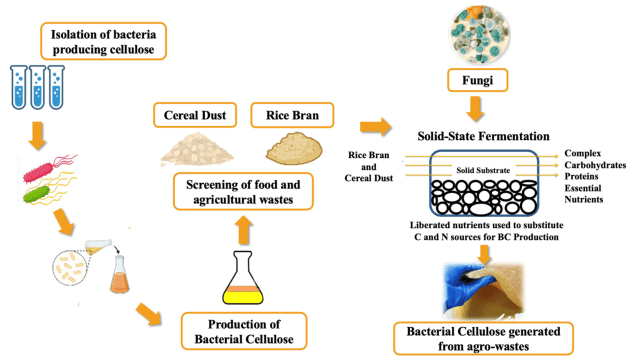
This process makes nutrients more accessible for the second stage, where bacteria convert these nutrients into pure bacterial cellulose.
“Using rice bran pre-treated with Rhizopus oligosporus, we achieved a 22 per cent increase in bacterial cellulose yield compared to untreated materials,” said Butardo.
“Our process demonstrates that agricultural waste can be viewed as an untapped resource rather than a disposal problem. This research showcases how innovative biotechnology can help close the loop in our food and materials systems.”
The research has significant environmental and commercial implications for industries seeking sustainable alternatives to synthetic products.
The global bacterial cellulose market is experiencing rapid growth, projected to reach $1.5 trillion by 2028 with applications spanning food packaging, water filtration membranes, wound dressings, artificial skin, and components for flexible electronics.
The team is hoping to scale up the technology to make a difference with sustainable biomaterials, implementing the process commercially and internationally with industry partners and other sectors.
The full research paper was published in Foods in September 2024, and is available to view here.


