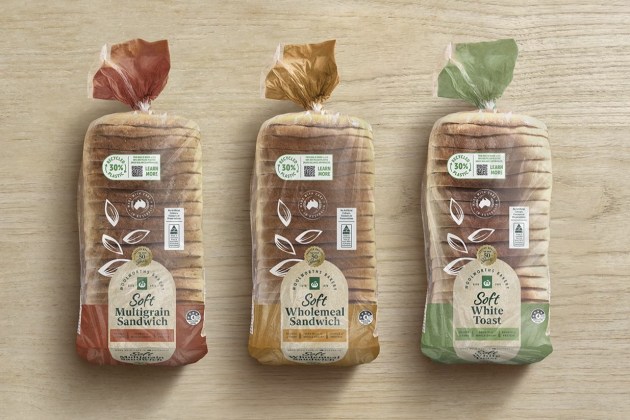
Woolworths has shifted its Own Brand sliced bread bags to flexible packaging manufactured by Amcor that contains 30 per cent recycled plastic, a move the retailer says will save about 50,000 kilograms of virgin plastic annually.
The change, which began in June, applies to six products: soft white sandwich, soft wholemeal sandwich, soft white toast, high fibre white sandwich, soft multigrain sandwich and high fibre multigrain sandwich. The low-density polyethylene (LDPE) food-grade bags are made using recycling technology via the mass balance approach*.
Bryan McKay, head of packaging sustainability at Woolworths, said the change reflects customer demand.
“We understand our customers want us to remove and reduce plastic and improve recycling opportunities from the products we sell, so we’re firmly focused on innovative ways to improve packaging and offer more sustainable options wherever we can,” McKay said.
He went on to add that working with Amcor and incorporating recycled content into the bread bags is another step towards Woolworths' goal of reducing virgin plastic and championing a more circular economy.
McKay said reducing waste across the value chain is a shared challenge. “We will continue to innovate with our Own Brand product range in terms of reducing plastics, increasing recycled content and improving recyclability, while strongly advocating for harmonisation of plastics in packaging regulation to progress sustainable packaging outcomes.”
For Amcor, the partnership shows how packaging can support circularity, a view held by Gerald Rebitzer, vice-president of sustainability operations and advocacy for Amcor Europe & Asia-Pacific.
“These bread bags are recycle ready and include 30 per cent recycled content, a clear example of how we can help keep plastics in use and reduce waste,” Rebitzer said.
“We believe all packaging can be designed to be circular and that packaging waste can be eliminated. Circularity is one of the areas where we can make the greatest positive impact, and this innovation shows how collaboration across the value chain with partners like Woolworths can turn that ambition into reality.”
The bags can be returned for recycling at 500 Woolworths stores in New South Wales, Victoria, Queensland and the ACT as part of a soft plastics collection pilot.
Woolworths said other packaging changes in recent years include paper-based pouches for Macro brand products, recyclable paper-based trays for meat, and recycled plastic containers for in-store bakery goods.
*In the case of plastic packaging, mass balance refers to the proportion of material coming from processing recycled plastic vs. that coming from virgin sources during the manufacturing process of plastics. This means you can’t trace how much recycled plastic makes its way physically into the packaging of each individual bread bag.