A new categorisation system for food scares will make the creation of prevention strategies more efficient according to researchers.
Researchers from the University of Surrey found existing categories are too simplistic, as they don't recognise contributing factors, according to a study published in the British Food Journal.
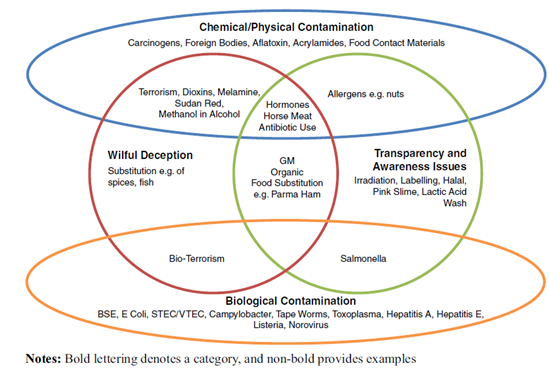
To give greater clarity and consistency to the sector, the researchers worked with industry experts to develop a new categorisation system (see image).
Unlike previous systems, this new categorisation structure enables a food scare to be classified according to both its physical manifestation (chemical/physical or biological contamination) and the origins of the scare (wilful deception and/or transparency and awareness issues).
By highlighting where and how the nature of different types of food scares overlap, it is hoped that this classification will enable risk management teams to address categories of potential scares in a systematic way and develop effective strategies to avoid future occurrences.
“With food scares becoming more frequent, it is important that we have a categorisation system which enables efficient development of strategies to tackle such compromises to our food supply,” co- author of the report Professor Angela Druckman from the University of Surrey said.
Dr Elizabeth Whitworth from RSK ADAS, and formerly of the University of Surrey, said: “The salient feature of the new categorisation is that it distinguishes between scares caused by wilful deception, and those that are caused by transparency and awareness issues.”
During the study researchers also found current definitions of the term ‘food scare’ to be inadequate as they fail to acknowledge consumers’ lack of trust in the food chain.
Researchers pointed to the 2013 horse meat scandal, which although was not harmful for human consumption, created a wariness amongst consumers of the food and supply chain.
As a result, the following new definition of a food scare was also developed by the researchers.
“A food scare is the response to a food incident (real or perceived) that causes a sudden disruption to the food supply chain and to food consumption patterns.”