Nutrition was the keycornerstone of Nestle when the company was founded by Henri Nestlé in 1867. His first infant formula was created to save the life of a neighbour’s child, a premature baby, whose mother was unable to breast feed and suffering from malnutrition.
Today, approximately 5000 people continue to work in Nestlé R&D to find solutions for complex nutritional needs, and to break ground in the business sector where food and beverage meets the pharmaceutical industry.
This is a strong focus for the company’s South American operations, and Nestlé recently completed the largest investment within the dairy industry in Chile for the last 50 years.
The company has commissioned its new Nestlé Osorno plant in Chile, which produces powdered milk products and ingredients with added nutritional value for export and the local market.
As with any infant formula plant, intermediate storage is necessary between the spray dryer and the mixing lines. Typically, this was done using side-door containers and an associated tilting station to provide traceability and intermediate bulk storage, technology that has been in use for the past 40 years.
In 2005, Nestlé contacted Matcon to evaluate cone valve technology in a bid to step up the quality of its process equipment. After two years of in-depth investigation, including numerous full scale tests and technology audits, Nestlé approved the technology for the handling of base powder and additives in infant formula.
The technology provides good containment, thanks to the alpha-beta coupling, Matcon says. Also, because no process zone is exposed to the atmosphere at any time, this ensures that the product is further protected from outside contaminants.
The Matcon discharge station is fully automatic after the intermediate bulk container (IBC) has been loaded. Discharge will only happen when requested from the downstream process, preventing choked processes and head load variation. Also, because the IBC is not tilted during discharge, there will be no contaminants falling from the container roof.
Finally, with the use of an automatic docking unit (ADU), an IBC is automatically filled without the need for an operator to remove and replace the IBC lid.
At the end of 2010, Matcon was awarded with an order from Nestlé and equipment has now been installed and commissioned. It has been successfully in operation since 2012.
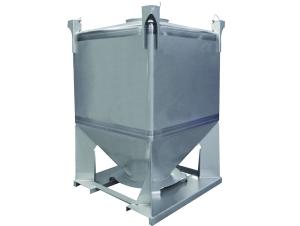 Nestle uses Matcom's cone valve technology in its spray drying plant.