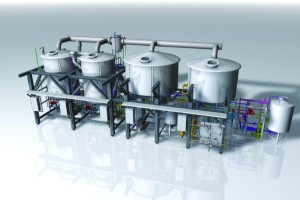
Growth of the craft beer category has led to demand for compact production technology that offers in-line flexibility. Krones is delivering big technology on a small scale with its modularised CombiCube family.
The trend towards craft beers reflects consumers’ ready acceptance of, and desire for, individualised product concepts. So, for craft beer brewers, flexibility in the production process is important.
Learning lessons from “big” brewing technology and using them for making specialty beers in small batches, Krones has delivered the CombiCube system, encompassing the principle of combinable cubes, which, Krones says, is this: “Think big, act flexible, and produce small”.
CombiCube is designed for smaller, specialty breweries with up to 250,000 hectolitres of sales-quality beer, ones that handle a diverse range of types and seasonal products.
Large industrial-scale breweries can use the CombiCube system to brew small batches for their specialty beers, or as a pilot installation or a mobile brewery. The system is modularised in construction, and it can be customised and easily expanded.
The type and number of vessels can be selected to suit the requirements involved. With CombiCube, breweries have an option for making top-quality products using different brewing processes and high volume variance. The three “cubes” are the CombiCube B brewhouse, the CombiCube C cellerage unit and the CombiCube F filter.
Their designs are derived from large installations, like ShakesBeer, Twin-Flow System or TwinPro, but their functionalities have been retained, and the construction simplified. This makes field-proven, operator-friendly technology accessible to small and mid-tier breweries.
Compact brewhouse
CombiCube B – the compact brewhouse – covers an output range of 40 to 100 hectolitres of hot cast wort with up to ten brews a day and original gravities of up to 15 degrees Plato with 98.5 per cent extract yield.
Cellarage under control
The CombiCube C is a good choice for breweries who are operating a classical fermentation cellar, with the tanks linked up by means of hoses, but who still want to reap the benefits of a process control system and are therefore planning to refurbish their cold area. The newly developed concept combines the freedoms of a hose-type cellar with a perfect overview of what’s happening throughout the fermentation cellar.
It offers an output range for filling and draining operations of up to 110 hectolitres an hour, a yeast harvesting capability of six hectolitres an hour, and is thus appropriately dimensioned for the CombiCube series or breweries with up to 250,000 hectolitres of sales-quality beer.
Modularised filtration
Five functionally defined modules are optimally synergised in the CombiCube F, and can be appropriately combined with each other to suit the brewer’s needs: the filtration module, the buffer module, the carbonation module, the disposal module and the CIP module. Subsequent expansions will present no difficulties, thanks to the modularised construction.
The wide regulation options for the filtration output, made possible by the twin-flow principle, offer simple solutions for complex job profiles. The CombiCube F operates in a nominal output range from 26 to 104 hectolitres an hour, with continuous running times of up to 14 hours. It is available in six different sizes.
Eco-friendly aspects
The CombiCube system scores well in terms of high energy-efficiency, thanks to the use of frequency-controlled motors and of Evoguard valves for minimised compressed-air consumption.
A high level of media-efficiency is assured, due to low consumption of primary energy and water, plus reduced cleaning consumption levels and times. Eco-compatibility is guaranteed by the use of ecological cleaning agents and minimised lubricant consumption.