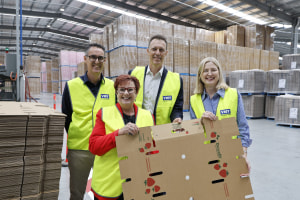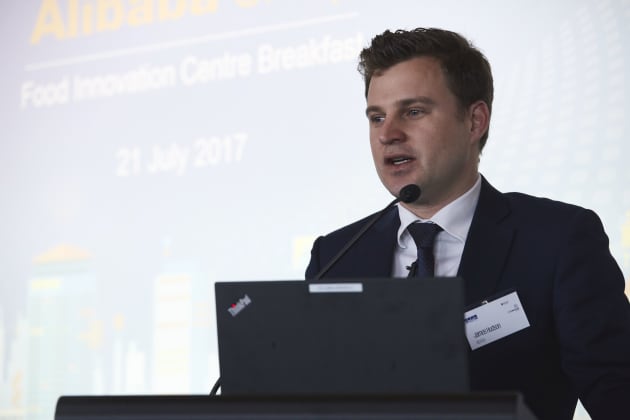
Australian food and beverage companies gathered at the new KPMG Innovation Centre in Melbourne's Docklands Last Friday to learn how to boost their hit-rate when launching new products.
The burgeoning China opportunity was the topic of the day - more specifically, how Australian businesses can access the growing ranks of the country’s middle class.
Monash University’s Food Innovation Centre hosted the event to improve Victorian manufacturers’ success when launching new products. According to research conducted by the centre, 90 percent of new products fail within the first year.
But, by developing goods in collaboration with consumers, and amassing critical knowledge about target markets, the Food Innovation Centre believes it can significantly improve that metric.
To that end, keynote speaker James Hudson, Alibaba’s director government relations, corporate affairs and marketing for Australia and New Zealand, revealed some of the opportunities provided by the online platform’s enormous reach within China.
Founded in 1999, Alibaba currently has a $US360bn market cap and expects to have a base of 2bn customers across China, Russia, Brazil, India and South-East-Asia by 2026.
While not targeting Australia for either its business-to-business or business-to-consumer offerings, it is actively attempting to grow the number of local companies that sell through its Tmall and Tmall Global marketplaces.
At present, over 1300 Australian businesses sell through the platform, but their impact is outsized: Chemist’s Warehouse, for instance, is now the largest overseas participant on the platform worldwide.
While Australia is already well-known in China for its high-quality organic goods, such as baby and maternity products, health and nutrition, cosmetics, and food and beverages, with the rapid improvement of China’s cold-chain, there’s growing demand for beef, dairy, oats and cereal, as well fresh fruit and vegetables.
Guo Fei, the lead researcher on many projects at China National Cereals, Oils and Foodstuffs Corporation, a state-owned food processor, manufacturer and trader, advised Australian businesses that the key to success is to develop a nuanced understanding of the Chinese customer.
Guo pointed out that while many foreigners view the much-discussed middle class as a homogenous unit, it’s a deeply stratified group. She divided the demographic into four areas:
- Millennial Middle Class that cares more about personal life that familial responsibility, and prefer novel foods to established products
- Steady Middle Class who want a healthy lifestyle and low-key luxury
- Struggling Middle Class who are focused more on planned consumption
- Upstart Middle Class who are often poorly educated but want showy luxury goods
However, these categories are changing so rapidly that Guo suggests that market research or proxy panels are not enough. The only way to truly get a grip on the swiftly-growing market is to cultivate a deeper connection with the culture. She suggests that making a Chinese friend (in China) is a great place to start.
Watch out for an in-depth feature on Alibaba, COFCO and export opportunities in China in the next issue of Food & Drink Business.