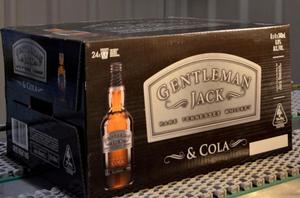
American spirit and wine giant Brown-Forman produces a number of well-known brands in the Australian market including Jack Daniels, Southern Comfort, Finlandia Vodka and Woodford Reserve.
Its new Gentleman Jack Whiskey and Cola premix canned drinks are made at its bottling plant in Victoria, and the plant uses a number of different types of adhesives to add load stability to finished pallets of product while they are in transit.
The problem was that these adhesive systems did not work consistently, and caused considerable damage to the cartons, with fibre tears and graphic delamination.
Brown-Forman’s marketing team designed a high-graphic cardboard package for the Australian launch of the new Gentleman Jack premix and the company didn’t want to use an adhesive that could affect the quality of the secondary packaging.
The company searched for a suitable load stabilisation alternative that would provide increased efficiencies, load stability with the possibility of stretch film reduction, and no damage to the packaging.
Brown-Forman’s search led to a working partnership with ITW Industrial Packaging and an introduction to its load stabilising adhesive, Lock n’ Pop.
This adhesive combines exceptional shear and tensile strength, with a low peel strength. This ensures cartons on the pallets remain unified in transit, but can be easily separated at their destination.
Unlike other systems on the market, no heating is required for the Lock n’ Pop adhesive. There is no over spraying or dripping from Lock n’ Pop, unlike hot melt or PVA adhesive systems, which can contaminate conveyors and cause misalignment of cartons and jams.
Samples of the Gentleman Jack cartons were sent to ITW Industrial Packaging for evaluation and testing to determine the correct adhesive and the rate of applied volume of adhesive to the cartons.
After the initial Gentleman Jack cardboard trials, a successful inline production trial was conducted. Some national logistical trials then took place and the results of these were excellent, according to ITW.
The conversion to Lock n’ Pop as a load stabilisation adhesive was carried out on a very tight timeline, but Brown-Forman adopted the new load stabilising adhesive without any start-up issues at a manufacturing level.
Lock n’ Pop has proved to be very consistent in its five months of operation, and works well with all machines involved, and Brown-Forman is pleased with the clean and unmarked finish, and the elimination of fibre tear and graphic delamination that has been achieved with the system.
Pallets exhibit unity as one complete block with excellent logistical results. By installing the Lock n' Pop system, the bottling line has reduced down-time, increased throughput and will help Brown-Forman with its packaging waste reduction policy by looking at future reduction of pallet stretch wrap.