End of line is where the gains from upstream value-add are banked, and it is also where complexity tends to creep in – mixed SKUs, late changeovers, staffing gaps and fluctuating demand. Foodmach Strategy & Sales director, Phil Biggs, explains how to build an end-of-line solution that scales with your speed.

Foodmach frames this challenge through a simple but powerful lens: Stack/Wrap/Track. These three functions form the backbone of a future-ready end-of-line operation. Stack ensures pallets, layer sheets and consumables are presented efficiently, without manual lifting or forklift congestion, and that pallets can be built quickly and accurately regardless of pattern or SKU mix. Wrap stabilises loads to specification, using minimal film and ensuring every pallet leaves the line with consistent containment. Track identifies each pallet with compliant SSCC labels and synchronised data, so inventory movements remain accurate and real-time.
When these functions are conceived, engineered and integrated as one, the result is an adaptable end-of-line architecture. Lines can start at low speed, evolve into a compact medium-speed cell, or scale into high-throughput operation – all under a single control layer. This reduces risk during growth, removes the “islands of automation” found in legacy setups, and creates a platform where changeovers, data and performance are managed coherently.
Low speed: autonomous, modular and labour-smart
For short batches, seasonal SKUs or pilot lines, performance is often lifted fastest by a smart cell that reduces manual handling and forklift movements rather than by a single large machine.
- DESTACK with an AMR
Starting with destacking, empty pallet and layer sheet presentation is handled by an autonomous mobile robot (AMR), which navigates safely around people and equipment and replaces repeated forklift trips. Manual lifting and traffic are reduced.
- STACK with a compact robot cell
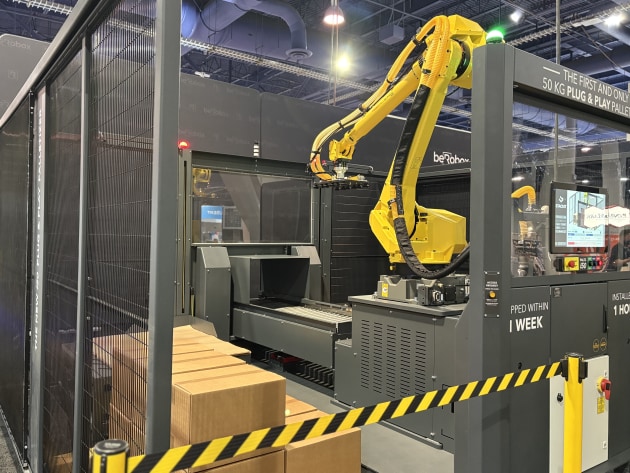
A pre-engineered robot cell such as Foodmach’s Instant Palletiser is dropped into tight footprints and brought online quickly. Rapid pattern changes and modest throughputs are supported through multi-pattern recipes and gentle case handling, providing a low-risk step from manual pallet building to automation.
- WRAP with a robotic semi-automatic wrapper
Within the same cell, a robotic semi-automatic wrapper is started by the operator and then applies the correct pre-stretch and overlap automatically. Load containment is kept consistent with minimal film usage and pallets move only a short distance inside the cell.
- TRACK when ready
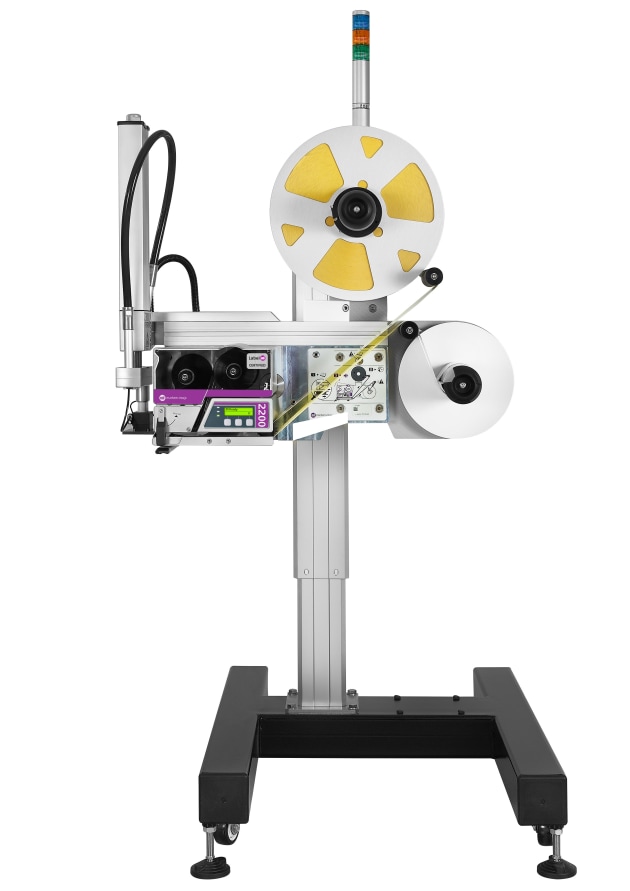
SSCC pallet labels can be applied and inventory events captured even at low speed. A Markem-Imaje compact print-and-apply system with job download from the ERP or WMS keeps despatch clean and compliant and removes last-minute manual labelling.
This architecture remains modular and budget-friendly, while manual tasks and errors are reduced and a repeatable process with a single point of control is created instead of separate islands of automation.
Medium speed: PALWRAPP – three jobs, one footprint
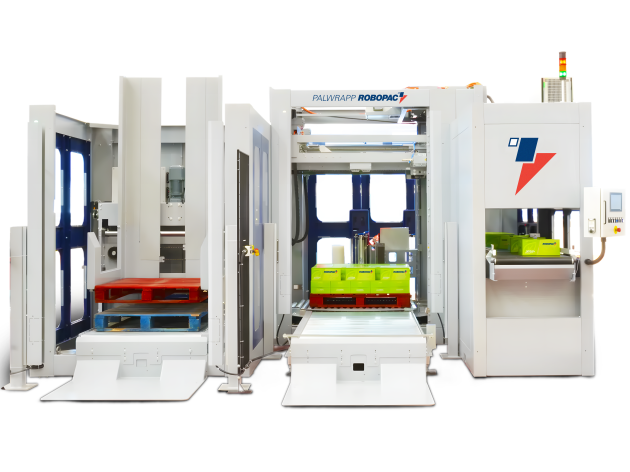
When floor space is constrained and throughput is rising, combination equipment becomes advantageous. Robopac PALWRAPP brings an integrated de-stacker, layer palletiser and wrapper together, eliminating the need for separate machines or long runs of conveying.
Functional stations are consolidated into a compact cell, allowing floor space to be reclaimed, guarding to be simplified and operator walking distances to be shortened. Layer-forming technology handles single SKUs, multi-SKU mosaics and heavy trays while pattern integrity is maintained at speed. Recipes are changed on the HMI without tooling swaps and layer squaring, and compression is built into the cycle for clean, stable loads.
The wrapper is matched to the palletiser’s cycle time, wrapping as layers are completed. Film pre-stretch and containment force are recipe-driven, delivering consistent stability with minimal film, and optional top-sheet and roping keep pallets weather-ready and warehouse-friendly. Frequent changeovers and variable case sizes are accommodated, and infeed accumulation, pallet print-and-apply, and data capture can be added without re-engineering the line.
For brands seeking higher volumes without surrendering floor space, PALWRAPP provides a direct step from manual end of line to a professional, high-uptime cell.
High speed: convey, palletise and wrap at line rate
For high-volume beverage and FMCG operations, the brief is straightforward: keep up with the filler, maintain pattern accuracy at speed and ship pallets that meet warehouse and retailer specifications every time.
Foodmach’s Robomatrix high-speed palletiser family is engineered for throughput and maintains precision while matching the upstream rate. Layer-forming, dual infeed and complex multi-SKU patterns are supported, and diagnostics with recipe management turn changeovers into a controlled routine rather than a production risk.
Source: Foodmach
A fully automatic Robopac wrapper provides hands-free operation, intelligent film usage and in-cycle testing to confirm containment force. Top-sheet application, corner posts and label applicators are integrated and wrapping parameters are linked to SKU recipes, so stability is locked in by product and performance is consistent across deliveries.
At high speed, SSCC labels are applied and verified automatically, and pallet events are posted to the WMS or ERP in real time. Coding platforms for case and pallet data, such as Markem-Imaje CoLOS, are integrated into the same control layer so product, case and pallet records remain aligned without manual reconciliation. This architecture removes classic pain points such as forklift congestion, pattern drift and unstable loads that trigger chargebacks and creates a clean data trail from case to pallet to truck.
Integration
Hardware on its own does not lift performance or OEE; integration does. Stack/Wrap/Track is most effective when delivered as one integrated system on a single control platform, with recipe-driven changeovers and a shared functional safety plan. In this configuration, changeover time and risk are reduced and stakeholders are presented with a common view of performance, diagnostics and data.
By generating, printing, applying and verifying GS1-compliant SSCC labels in the same automated flow that builds and wraps each pallet, and by combining this with recipe-driven wrapping and robotic handling, despatch times and chargebacks are reduced, product damage and forklift movements are lowered, and improvements are achieved in OEE, total cost and environmental footprint.
Selection of the right path is easier when three principles are followed: the main constraint at end of line is stabilised first, Track (labels and data) is designed into the initial scope rather than added later and a single owner is appointed for Stack/Wrap/Track to keep service, training and accountability clear.
At Foodmach, complete solutions are designed, built and supported with in-house mechanical, electrical and software capability, with a single team accountable for outcomes measured in OEE, labour saved and pallets that scan first time.
This article first appeared in the December 2025/January 2026 edition of Food & Drink Business magazine.