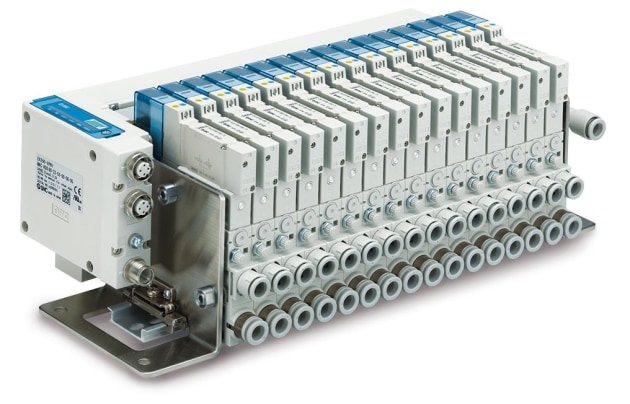
SMC Corporation’s new ZKJ vacuum manifold with ejector system is PROFINET-enabled to ensure remote control and monitoring of manufacturing processes, with an energy-saving component, air consumption is reduced by 90 per cent.
For the adsorption of work pieces with minimal vacuum leakage, the built-in check valve maintains vacuum pressure – significantly reducing the use of compressed air. The integral pressure sensor monitors vacuum pressure and automatically turns off the supply valve upon reaching the set value.
Other features include valve protection functionality, IP65 dust-tight or water-jet-proof rating with the use of M12 wiring connectors and the ability to control up to 16 ejectors with a single manifold.
Currently, the ZKJ series is compatible with PROFINET and requires no input/output unit.
These enhanced functions allow for easy set-up and access to valuable data.
PROFINET’s fast start-up function also makes it possible for an IO device to go from power on tocyclic data exchange in0.5seconds orless.
![WorldStar 2026 winners announced [UPDATED]](http://yaffa-cdn.s3.amazonaws.com/yaffadsp/images/dspArticle/featureImage/wpo.jpeg)