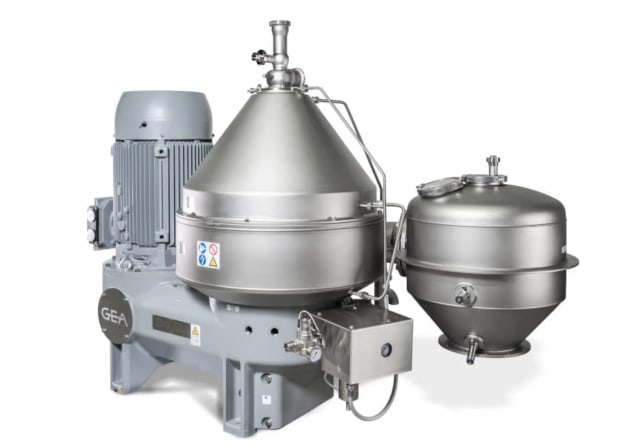
Global equipment provider, GEA, has launched the GSE 150 CPR, a new separator for clarifying pulp-rich citrus juices.
With the global citrus industry facing growing pressure, the machine is aimed at processors in the medium capacity range who want to keep clarification processes stable even with high and fluctuating solids loads and minimise juice losses in the pulp discharge.
According to Innova Market Insights, there is an increasing demand for premium products with defined texture profiles, where pulp content is a defined quality parameter, not a variable left to chance.
The GSE 150 CPR (Constant Pulp Removal) differs from conventional separators through the use of a separating disc in the self-cleaning bowl in combination with a second centripetal pump. This configuration enables the pulp to be continuously conveyed out of the machine under pressure – up to 4 bar.
The decisive effect: the solids-holding volume no longer plays a significant role in process stability. Even with highly fluctuating pulp content, as is typical for greening-affected fruit, the clarification process remains stable. Because part of the flow is continuously discharged, CPR separators process around 50 per cent more product than a conventional separator of comparable size.
In operation, the GSE 150 CPR typically requires only two to four solids discharges per hour. Fewer discharges mean fewer process interruptions, less product carryover during discharge, and a more stable restart after each discharge. By comparison, a conventional clarifying separator without continuous pulp discharge can reach up to 30 discharges per hour under high solids loading – with correspondingly higher juice losses and declining clarification performance.
The separator is designed for clarifying pulp-rich citrus juices – orange juice, grapefruit juice, lemon juice – and is also suitable for pulp washing processes and cloudy peel extract. As a design example, GEA cites capacities of up to 17,000 litres per hour for orange juice and up to 12,000 litres per hour for lemon juice, with the achievable performance depending on the product and solids content.
GEA area sales manager business line beverage, Rüdiger Flocke, said when raw fruit quality and solids content fluctuate more strongly, process stability becomes an economic lever.
“The GSE 150 CPR continuously discharges pulp under pressure and requires only a few discharges per hour – this makes clarification processes more robust and reduces product losses,” said Flocke.
All components that come into contact with the product are made of stainless steel; the seals meet food processing requirements. The separator is fully CIP-capable. For solids discharge, the bowl is opened and closed hydraulically with water. The drive is powered by a low-maintenance flat belt on a standard three-phase motor rated at 30 kilowatts. The bowl rotates at 5,300 revolutions per minute.
For operators with high availability requirements, the GEA InsightPartner Separation Monitoring is available as an option. Among other things, this online condition monitoring system continuously records vibrations and forms the basis for condition-based maintenance.
GEA is a global company, which supplies food and beverage equipment to companies around Australia, with its main headquarters located near Melbourne Airport, Victoria.