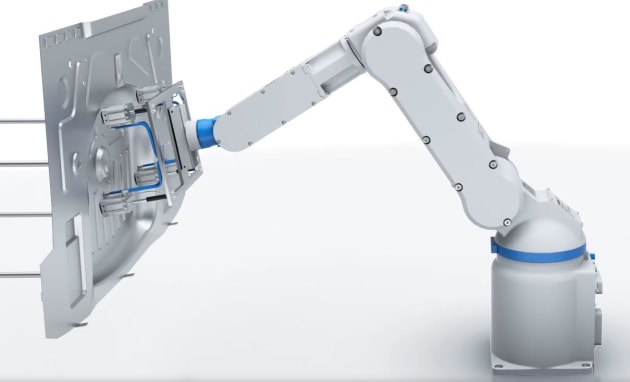
The MHM gripper range from SMC uses magnetic technology for product handling on irregular surfaces.
SMC Corporation Australia New Zealand product manager Guiomar Fernandez said the MHM is the answer to the problem of regular vacuum pads being unable to gain sufficient absorption of workpieces on uneven or perforated surfaces.
“With a holding force of up to 1000N, it keeps hold of the workpieces even when the air is shut off, offering peace of mind when it comes to reliable and safe movement of workpieces. Furthermore, with a residual force of 0.3 N or less, cycle times are reduced, and productivity output is improved,” Fernandez said.
The MHM series is ideal for cobot applications where suction pads and grippers will not perform optimally due to uneven or porous surfaces. Suitable for a range of transfer applications, the holding force of the MHM can be adjusted by changing the distance between the magnet and workpiece by the adjustment bolt. Made from Fluororubber, the bumper prevents damage to the workpieces, delivering cost savings.
“End effectors, primarily in the form of grippers, enable the business end of the cobot to handle and manipulate parts with a wide variety of shapes, sizes, and materials.
“The bumper also prevents the workpiece from slipping during operations, improving safety. Featuring three mountable surfaces and the option to mount auto switches, the MHM offers flexibility and greater process control,” Fernandez said.
![WorldStar 2026 winners announced [UPDATED]](http://yaffa-cdn.s3.amazonaws.com/yaffadsp/images/dspArticle/featureImage/wpo.jpeg)