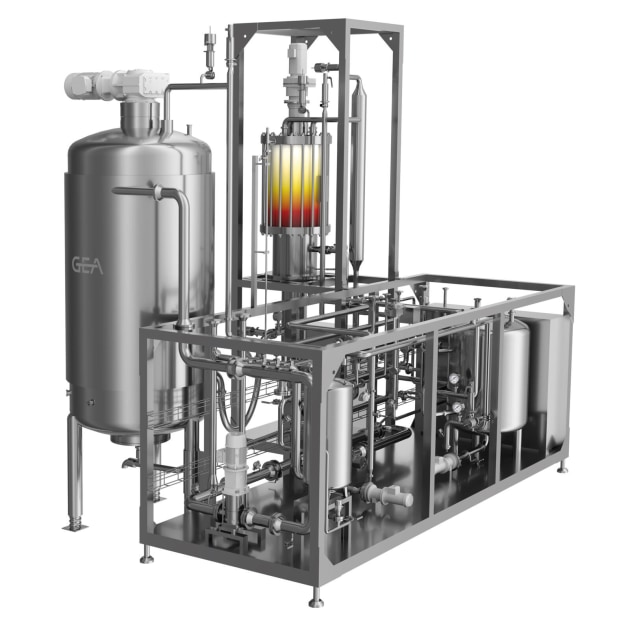
GEA’s new IceCon Compact series is designed to produce liquid food concentrates while preserving flavour and ingredients.
IceCon is suitable for high-quality fruit extracts, juices and dairy drinks, alcoholic products, cold-brew coffee, and even vinegar concentrates.
Freeze concentration plants remove the water from liquid foods to purify the product or to concentrate the flavour into a small volume for transport and further processing. This process achieves the highest selectivity because the grown ice crystals bind only the water. When the water is removed at the freezing point, the result is a concentrated syrup in which quality, aroma and all ingredients are completely preserved.
The newly developed compact series is an integrated solution for manufacturers with small to medium production volumes who require a dewatering capacity of 100-900 kilograms.
Operated continuously, the plant freezes and concentrates at low temperatures without the need to interrupt the process for cleaning. The units are delivered skid-mounted and tested, reducing installation and commissioning time.
Since the energy is recovered through a pre-cooling line and the system is electric powered, the carbon footprint could be reduced even further with green power.
The compact freeze concentrators are available in three sizes – IceCon Compact 25, Compact 40, and Compact 60.