


Taste and nutrition company, Kerry, has unveiled its 2026 Global Taste Charts – drawing on the expertise of over 1200 scientists, 100 flavourists, and extensive consumer research to map the forces reshaping how people eat and drink. Food & Drink Business spoke with Kerry ANZ general manager, Michelle Thomson, to uncover the flavour movements set to define the Australian market in 2026 and beyond.
The Australian palate continues to evolve at speed. Driven by a richly multicultural population and heightened exposure to global cuisine, local consumers are increasingly inspired by Asia, the Americas, Europe and into the Middle East, and are demanding products that feel both exciting and emotionally resonant. Kerry’s Taste Charts offer insight into these global signals and translate them into actionable direction for Australian food and beverage manufacturers navigating today’s fast‑moving market.

This year’s edition expands from six to eight product categories, offering insights into Refreshing Beverages; Alcohol & Alcohol-Inspired Beverages; Tea, Coffee & Cocoa; Savoury Snacks; Sweet; Soups, Sauces & Dressings; Meat & Meals; and Supplements.
Kerry ANZ general manager, Michelle Thomson, tells Food & Drink Business that the decision was driven by a diversifying industry and consumer base.
“In the beverage category alone, we’re seeing explosive growth in textural builds, layered formats, hybrid drinks, functional wellness and indulgent treats,” says Thomson.
“By separating the categories, we give our customers a clearer view of what’s trending now, what has real momentum, and what’s coming next.”
Alongside the flavour data, Kerry’s research identifies seven macro trends, the Sensational Seven, capturing the cultural triggers and motivations driving consumer choice: Category Crashers, Chain Reaction, Elevated Staples, Everyday Escapism, Heritage Reclaimed, Maximalist Flavour, and Simplicity Amplified.
The company said these aren’t fads, but long-term shifts that influence how consumers perceive value, comfort, novelty and authenticity. The convergence of technology and taste is expected to accelerate flavour innovation across the market. As data-driven insights become more accessible, manufacturers are better equipped to predict emerging preferences and respond with precision.
Emerging trends
Global signals reveal a consumer base seeking the duality of novelty and nostalgia, a blend that is surfacing rapidly in Australia. Maximalist flavour, modernised cultural blends and premiumised everyday staples are shaping some of the most commercially relevant trends for brands – manifesting differently across categories and consumption moments in the local market.
Key emerging trends Kerry identified in the Australian market include:
- Salty snack premiumisation – Australian savoury tastes are shifting toward bold heat, smoke and global street food cues as a pathway to value growth. Korean barbecue, teriyaki and chicken karaage anchor umami driven seasoning systems, supported by chilli profiles such as peri peri, chipotle and Szechuan pepper. Indulgent notes like smoked butter, honey butter and pepperoni, alongside birria taco, shawarma and satay, are helping deliver differentiation and premium appeal in salty snacks.
- Rise of regional Asian savoury heroes – in the meat, meals, and sauces categories, Australian consumers are moving beyond generic “Asian” cues toward clearly defined regional flavour identities. Korean gochujang and kimchi, Japanese teriyaki and yuzu, Southeast Asian flavours such as Thai satay, green curry and lemongrass, alongside Indian spice systems like tandoori and biriyani, signal authenticity and cultural specificity for younger Australian consumers.
- Dragon fruit emergence – dragon fruit is gaining momentum globally and is now emerging in Australia’s beverage landscape. Its vibrant colour and lightly sweet profile align with demand for thirst‑quenching, visually appealing drinks.
- Complex hot beverages – innovation in the tea, coffee, and cocoa category is evolving through layered sweet and spice led flavour builds that deliver indulgence and familiarity. Dessert driven profiles such as tiramisu, cheesecake and caramel brûlée add richness, while pistachio, almond and coconut cream contribute texture. Warming accents like chai, matcha, and brown sugar create complexity with a premium edge.
- Nostalgia-led sweet indulgence – a balance of nostalgia and novelty is redefining sweet indulgence, with flavour cues like chocolate fudge, apple pie, cinnamon bun and gingerbread. Playful twists such as bubble gum, cola and marshmallow introduce fun, while pistachio, ube and matcha add modern relevance.
- Refined refreshment – alcoholic beverages in Australia are shifting toward lighter, more refined refreshment profiles. Bright citrus and florals such as yuzu, finger lime, pink grapefruit and orange blossom deliver lift, while sour cherry and lychee add sophistication.
- Trading up in cheese – beyond cheddar and parmesan, consumers are increasingly trading up to texture rich, premium cheeses like parmigiano reggiano. The focus is on upgrading quality and mouthfeel without adding complexity.
Source: Snack Brands Australia
Australian market impact
According to Thomson, Maximalist Flavour is the most accelerated trend in Australia and New Zealand.
“Consumers are leaning into bold, layered and multisensory experiences. Whether it’s spice appearing in unexpected places or textural beverages that feel almost architectural, maximalism is showing up across CPG, inspired by street food and even fine dining,” she says.
The QSR-retail pipeline is accelerating these shifts. Flavours that trend in fast food are appearing on supermarket shelves within months, hot honey being one of this year’s most visible examples.
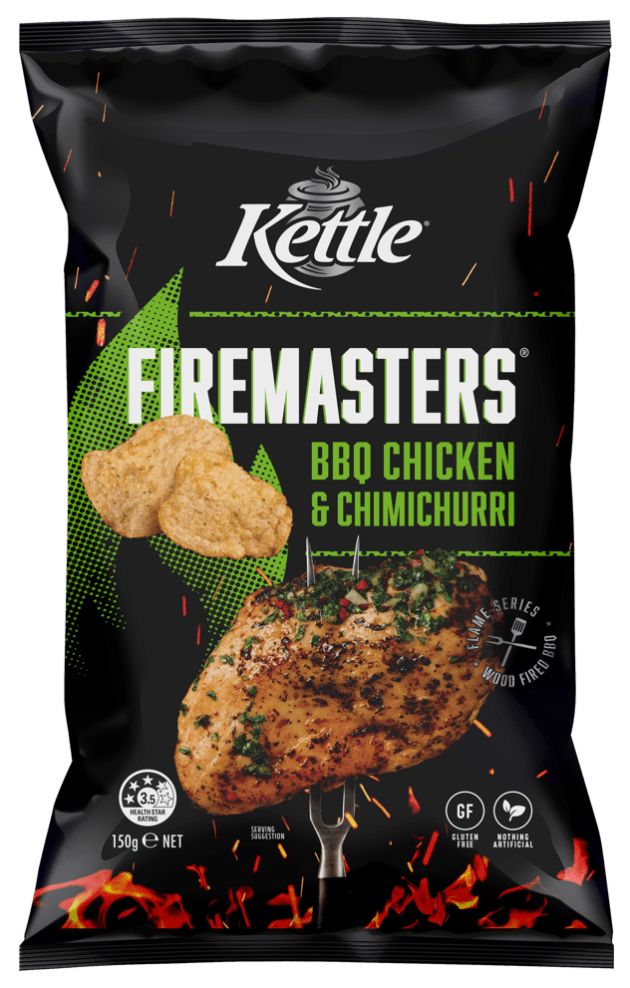
Snackbrands Australia’s Kettle Firemasters range demonstrates this well, translating street‑food inspiration into premium retail chips such as Woodfired BBQ Chicken & Chimichurri and Firepit Beef Brisket & Smokey BBQ Sauce.
“Even at a snack level, Australians are expecting flavours to work harder – layering comfort, heat and indulgence together,” Thomson notes.
“It’s no longer about a single hero note, but how those elements come together to feel satisfying and complete.”
This appetite for familiar formats taken one step further is accelerating, as brands balance recognisable foundations with deeper flavour expression.
Digital taste sensations
Kerry has more than 1200 scientists across 70 technology innovation centres around the world, working on nutrition, food, beverage, and pharmaceutical ingredients and products. The company’s work ranges from long-term reformulation to last-minute rescue jobs.
Alongside the 2026 Taste Charts, Kerry has launched an end-to-end digital platform where customers can instantly order samples of trending flavours – KerryNow.
Kerry VP of product technologies, Leigh-Anne Vaughan, said the food and beverage landscape is evolving at a breathtaking pace, and manufacturers are under more pressure than ever to meet the changing needs of today’s consumers.
“Brands cannot afford to simply react; they must anticipate and innovate at pace,” said Vaughan.
“We challenged ourselves this year to truly walk in the shoes of our customers, designing the new Taste Charts digital platform, powered by KerryNow, to allow them to unlock smarter, faster and more radical innovation.
“We want manufacturers to feel empowered and confident that their flavour decisions will engage target consumers. By making product information and samples available instantly, we are not just providing a roadmap for innovation – we are providing the fuel to get there faster.”
By removing early stage friction, long lead times, fragmented communication, and unclear alignment, KerryNow supports manufacturers to convert insight into prototypes within days rather than weeks.
The brands that thrive will be those willing to read these signals not as predictions, but as provocations – inviting them to rethink flavour, reimagine categories, and redefine what consumers will crave tomorrow.
Connection driving growth
Cost‑of‑living pressures are shaping not just what consumers buy, but the emotional role food and drink play in their lives. Kerry sees this as a defining lens for innovation in 2026-7.
With consumers facing continued cost of living challenges, the emotional impact of the food and beverage landscape has become a focus for Kerry, helping consumers to have uplifting moments.
“Consumers are starting to gravitate towards comfort flavours, and trends like Elevated Staples and Everyday Escapism is where you can combine familiarity with an uplift that drives emotion,” says Thomson.
“What does that mean for flavour? It’s tapping into nostalgia and feeling that elevating, offering emotional payoff. It’s about backing flavours that consumers will not just try, they’re going to repeat, and that’s what’s going to drive growth.”
For manufacturers, this means investing in flavours that anchor people during uncertainty, while still offering novelty or sensory richness that feels meaningful, not frivolous. In an increasingly competitive landscape, it will be the brands which balance creative flavour innovation and maintained consumer trust that will be positioned to succeed.
Kerry has over 50 years of experience in taste, nutrition, and food science. For further information on the flavours shaping the sector, Kerry’s 2026 Global Taste Charts are available online at explore.kerry.com.
This article first appeared in the Q1 2026 edition of Food & Drink Business magazine.


