


Key emerging food trends could be worth $25 billion by 2030 according to new analysis released by CSIRO at the inaugural Global Table conference in Melbourne today.
Economists in the national science agency’s strategic advisory arm, CSIRO Futures, released an economic valuation – Growth opportunities for Australian food and agribusiness: Economic analysis and market sizing – on the opportunities it identified in its 2017 CSIRO Food and Agribusiness Roadmap, including plant-based protein, foods for health and wellbeing and the growing circular economy.
CSIRO Futures senior economic adviser, Dr Katherine Wynn found that health and wellness, sustainable solutions, and premium segments will see higher growth (3.6 per cent per annum, in real terms) compared to the food and agribusiness industry as a whole (2.4 per cent per annum), but achieving these predictions will depend on continued investment and innovation.
Global consumer trends for sustainable, ethical and healthy food products combined with growing demand from export markets buying into Australia’s reputation for clean and green products are driving growth, she said.
Advancing the roadmap
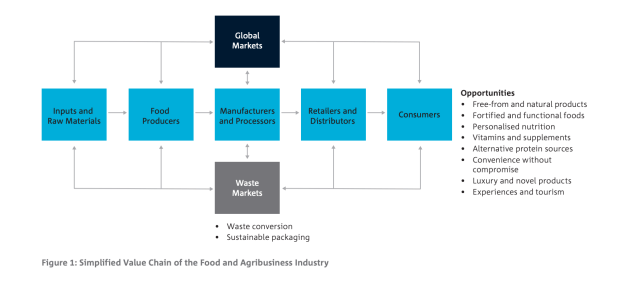
The 2017 Roadmap identified 10 opportunities in the areas of: products for health and wellbeing; sustainable solutions; and premium interactions. The valuations released in today’s report provide an outlook on the market size of growth opportunities with a focus on domestic consumption and export opportunities.
Australia’s gross domestic product (GDP) was $1.8 trillion in 2018. The food and beverage manufacturing sector contributed 1.5 per cent or $27 billion, agricultural sector 2.5 per cent ($46 billion) and the food and beverage wholesaling, retailing and services contributed a further $65 billion (3.6 per cent) to GDP.
Combined, this broad food and beverage industry contributed 7.6 per cent or $138 billion to GDP – compared to other sectors like mining (eight per cent), building and construction (8 per cent) and electricity, gas and water supply (2.5 per cent).
Demand from the Asia-Pacific is likely to underpin export growth in food and agribusiness across all three areas. Our food and agribusiness exports to China, Japan, Indonesia, Korea, India and Vietnam have grown from 42 per cent of total food exports in 1997 to 57 per cent in 2017.
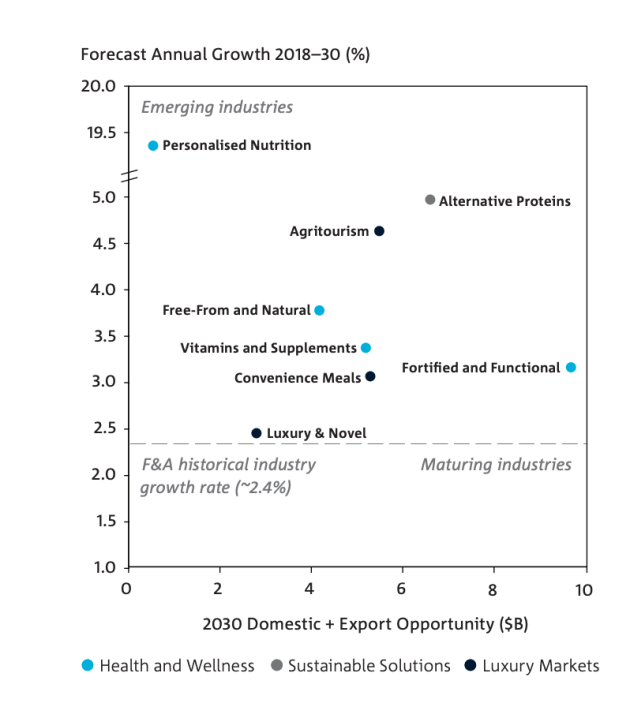
The opportunities and projected growth figures within wellness, sustainability and premium segments vary in magnitude due to trends in consumer preferences and/or differences in industry maturity, the report said. For example, strong demand for alternative proteins is expected to grow continue with rising consumer preference for sustainable and ethical foods, and strong population and income growth in key export markets with large vegetarian populations such as India.
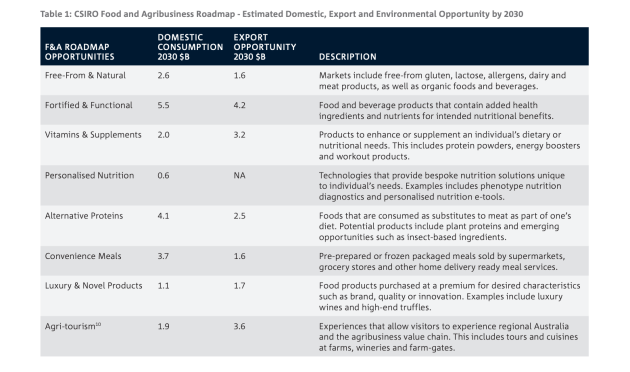
For other areas the outlook is a little more conservative. Demand for convenience meals will depend on how the industry competes with alternatives such as fast-food, food delivery services and local eateries.
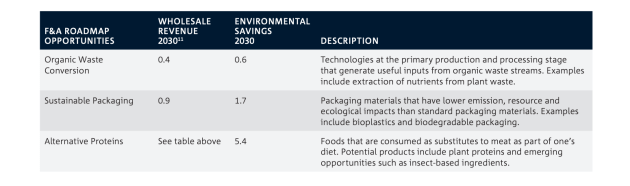
When it comes to sustainable solutions in the form of organic waste conversion and sustainable packaging, the report found economic activity will increase in secondary waste markets, deliver benefits across the value chain through new efficiencies, and meet consumer expectations for sustainable and ethical products.
Opportunity sizes are not necessarily reflective of growth or realised value under business as usual. Attractive growth prospects are likely to attract significant competition overseas. Hence, it is possible that some or much of domestic consumption for each opportunity are met by overseas imports. Likewise, the export opportunity may not be realised if local industry supply does not exist or compete strongly with competition overseas, CSIRO said.
Health and wellness
In the personalised nutrition space CSIRO expects R&D rather than commercialisation will characterise near-term spending. “Personalised nutrition may grow into a significant opportunity by 2030 or beyond as its efficacy, affordability and accessibility improves,” it said.
Today, more than 40% of Australians identify eating fresh fruit and vegetables as a top food priority, and around 24% identify reductions in sugar and fat intake, and eating healthier snacks as top health priorities. Growth in real expenditure per person in health and wellbeing has grown at 1.7% per annum, a strong signal of society’s investment and emphasis in health and wellbeing. These factors combined reflect consumer appetite and willingness to pay for health and wellbeing products.
The CSIRO valuation estimates that domestic consumption and export opportunity for free-from and natural foods will reach $4.2 billion by 2030 at around 4 per cent per annum growth. Key markets include soy and other milk alternatives, gluten-free bread and lactose free milk products.
The emergence of products such as natural sweeteners, natural preservatives and tolerable alternatives to lactose, gluten and allergen free products may also contribute. “The rise in demand for natural, sustainable and ethically sourced foods, as well as Australian industry’s global reputation for ‘clean and green’ food, should support growth in this opportunity,” the report found.
International research has found that about 30 per cent of consumers have expressed a willingness to pay for personalised nutrition services at an average premium of 50 per cent relative to non-personalised nutrition products and services, CSIRO said.
Food provenance and traceability
CSIRO expects food provenance and traceability to become an increasing priority for industry and government over the next few years. Food fraud in the form of product adulteration, substitution, diversion, misrepresentation and/or identity theft will create safety and reputational risk. The economic cost of food fraud to Australian agri-food exports was estimated at $2.3 billion in 2017 and will increase with global industry growth.
Product quality, trust and security is critical to Australia’s reputation and competitive advantage, so heavier investment in digital and chemical identifier technologies, sensor technologies and distributed ledger technologies over the next 5-10 years is expected, CSIRO said.
Transition towards a circular economy
Achieving circularity is estimated to yield US$49.8 billion in net material cost savings across global packaged food, fresh food and beverages industries annually. The growth opportunities in organic waste conversion and sustainable packaging should attract greater investment as businesses seek better mechanisms to reuse, recycle, reprocess and recover waste and secondary materials for production.
Australia generated 67 million tonnes of waste in 2016-17, an increase of 6 per cent (3.9 million tonnes) over an 11-year period. Australia also records a higher material footprint per capita relative to other trade intensive economies such as China and the US. This reflects our higher use of biomass, construction minerals, fossil fuels and metal ores for economic activities.
The United Nations Sustainable Development Goals have set targets to halve per capita global food waste and substantially reduce waste generation through prevention, reduction, recycling and reuse by 2030.
The Australian Government announced its commitment to ensure 100 per cent of packaging to be reusable, recyclable or compostable by 2025. The plan includes targets to ensure:
-
70 per cent of plastic packaging is recycled or composted;
-
the average recycled content of all packaging is increased by 30% by 2025; and
-
single-use plastic packaging is phased out through design, innovation and alternatives.
CSIRO analysis projects that under these targets, Australia could recover $90 billion in wholesale revenue of secondary packaging materials and deliver around $1.7 billion in net carbon emission, water and energy savings annually by 2030.
The full report is here.


